The Narrator Reunites with His Birth Parents and Leaves the Orphanage
The Painted BirdThe narrator’s reunion with his birth parents and departure from the orphanage turn a long-awaited discovery into a new conflict over belonging. A birthmark establishes that the frail, grieving couple are his parents, but it cannot make their love feel familiar or erase the independent life he has imagined. He leaves with them, yet the scene closes not in uncomplicated homecoming but in uncertainty: protection, family rights, and the return to ordinary life threaten to narrow the world he has made for himself.
Summons and Recognition
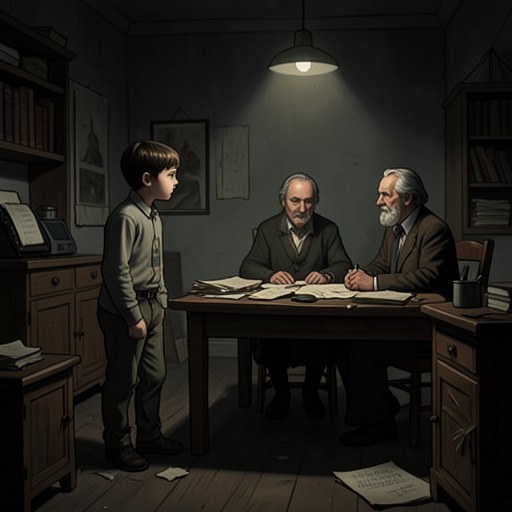
Early one morning, a teacher calls the narrator out and tells him that the principal wants him in her office. He first suspects that the summons may bring news from Gavrila, but doubts grow as he walks there. The principal is waiting with a member of the Social Commission, the man who believes he knew the narrator’s parents before the war. Their cordial greeting and invitation to sit down are accompanied by visible nervousness, while voices from an adjoining office signal that the meeting is about to become more than an administrative conversation.
The Commission member goes into the adjoining room and speaks with someone before opening the door. A man and a woman stand there. Their faces seem familiar; beneath the star on his uniform, the narrator feels his heart beating and studies them while trying to appear indifferent. The resemblance is striking enough that he recognizes the possibility they are his parents, but he hesitates over what recognition would require: he could acknowledge them, or pretend not to know them.
The woman bends toward him, her face creased by tears. The man supports her, nervously adjusting the spectacles on his damp nose, and shakes with sobs before recovering enough to address the boy. He speaks Russian fluently, in a manner the narrator associates with Gavrila, then asks him to unbutton his uniform. A birthmark on the left side of the narrator’s chest will identify him. The recognition is therefore both intimate and evidentiary: the couple’s grief gives the meeting its emotional force, while the mark supplies the proof that appearance alone cannot provide.
The Birthmark and the Choice to Stay
The narrator already knows the birthmark is there. He understands that revealing it will remove any doubt that he is their son, and for several minutes he considers withholding that confirmation. His hesitation is not a failure to recognize the couple; it is fear of what recognition will set in motion. He feels sorry for the crying woman and slowly opens his uniform. The mark is visible, and his parents bend over him, crying, hugging, and kissing him.
Even then, the narrator imagines escape. He could run away, board one of the crowded trains, and travel until no one could trace him. Yet he decides not to flee, partly because he wants Gavrila to find him and believes remaining where he is makes that more likely. The choice holds two incompatible hopes together: he accepts the encounter with his parents, but still looks toward the future he has formed elsewhere.
That future is vividly specific. Rejoining his parents means giving up his dream of becoming a great inventor of fuses that could change people’s color, and of working in the land of Gavrila and Mitka, where tomorrow already seemed to have arrived. The invention and imagined homeland are not incidental fantasies in the scene; they give shape to the life he fears losing. Against them, the family reunion offers a real identity and a claim on him, but not the future he had chosen for himself.
The narrator recalls Gavrila’s teaching that parents have a right to their children. He is only twelve, not yet grown, and understands that even reluctant parents would have a duty to take him away. This makes the outcome feel less like a decision wholly within his control than a responsibility attached to his age and identity. His parents do not look like people who will beat him; they seem frail and ailing. Their gentleness, however, does not dissolve his resistance. The narrator finds it difficult to imagine becoming someone’s real son, receiving caresses and care, and obeying not because someone can hurt him, but because parents possess rights over their child.
Leaving the Orphanage
The narrator’s father returns, and both parents embrace him, look him over, and exchange comments about him. The time has come to leave the orphanage. Before going, the family says goodbye to the Silent One. He regards the parents suspiciously, shakes his head, and refuses to greet them. His response marks the departure as a separation from the people and relationships formed in the orphanage, not simply a change of address. The boy is leaving with the family whose identity has just been proven, while the Silent One offers no welcome or blessing for the transition.
Outside, The narrator’s father helps carry his books. The streets are crowded with ragged, dirty, haggard people bearing sacks as they return to their homes and quarrel with those who occupied them during the war. The departure therefore unfolds amid a wider, unsettled return: people are trying to reclaim homes and ordinary lives, but the process is visibly contentious. Between his parents, the narrator feels their hands on his shoulders and hair. Their touch is protective, yet he experiences their love and protection as smothering. The physical closeness makes the emotional contradiction immediate: he is being cared for, and he feels confined by that care.
A New Household, an Unsettled Homecoming
The parents take the narrator to an apartment they have borrowed with great difficulty. They learned that a boy matching their son’s description was at the local Center, and that information made it possible to arrange the meeting. The apartment is thus the practical destination of the search, but not a recovered childhood home. It is borrowed, and the family’s reunion begins in a precarious postwar setting rather than in a settled household waiting unchanged for the boy’s return.
There is another child in the apartment, a four-year-old boy whom the parents adopted. He is an orphan: his parents and older sister were killed, while his former nurse saved him and handed him to The narrator’s father during the family’s wanderings in the third year of the war. The narrator can see that his parents love the younger child. This discovery complicates the reunion further. The household already contains a relationship of care formed through wartime loss, and the narrator must enter a family whose bonds and routines developed while he was absent.
The scene leaves the narrator doubtful rather than reconciled. He wonders whether he would be better off alone, waiting for Gavrila to adopt him. He would prefer, he thinks, to wander again from village to village and town to town, never knowing what might happen. In the apartment, everything seems predictable. The contrast reverses the usual promise of safety: uncertainty and exposure had been dangerous, but they also made room for movement and possibility; a stable home offers protection at the cost of a freedom the narrator has learned to value.
Significance of the Reunion
As the narrator considers what has happened, his world feels cramped, like the attic of a peasant’s shed. He sees two kinds of threat surrounding a person: the snares of those who hate and persecute, and the arms of those who love and wish to protect. The comparison does not equate parental affection with persecution; it shows how little control he feels he has over either condition. In both, other people can determine where he belongs and what happens next.
The birthmark settles the question of identity but not the question of attachment. The parents’ tears, embraces, and claim on their child are real, and the narrator does not deny their tenderness. Yet the return does not restore an uncomplicated former self or immediately make him feel at home. It forces him to exchange a precarious freedom and a projected future with Gavrila and Mitka for kinship, care, and obedience. The departure is therefore a homecoming in fact and a dislocation in feeling: the narrator is found, but belonging remains something he cannot simply accept because it has been proved.